
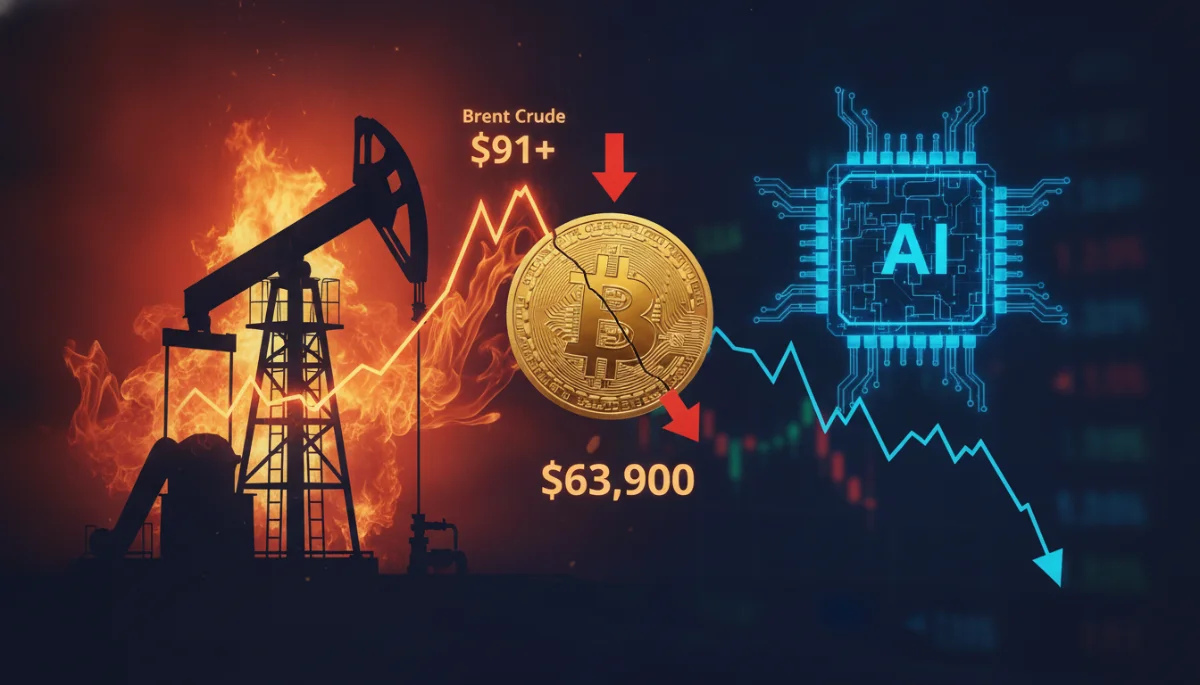
Dual Market Pressures Drive Crypto Decline
Bitcoin has slipped below the $64,000 threshold on July 20, 2026, as the cryptocurrency market faces a convergence of negative macroeconomic and sector-specific forces. The primary drivers include a sharp rally in oil prices fueled by escalating U.S.-Iran geopolitical tensions and a continued selloff in the technology sector driven by disappointing artificial intelligence earnings. Brent crude oil surged past $91 per barrel, marking its highest level in a month and reigniting inflation fears that typically dampen investor appetite for speculative assets like digital currencies . Simultaneously, the tech sector is under pressure following weak earnings from major Asian chip manufacturers, causing South Korea’s Kospi index to drop 3.5% and creating a sentiment spillover effect that negatively impacts crypto markets due to their perceived technological linkage . Shaurya Malwa, a Crypto Market Analyst at Bullish Inc., describes the situation as a tug-of-war where inflation anxiety from rising energy costs competes with uncertainty in the AI technology sector. This balancing act has led investors to cautiously position their portfolios, resulting in the recent dip under $64,000 . The market is effectively navigating a triple headwind consisting of macro caution ahead of the Federal Reserve meeting, inconsistent Bitcoin ETF inflows that fail to provide a durable institutional bid, and weak spot demand facing technical resistance near the $64.5K to $65.5K range . h2>Price Performance and Market Mechanics
The decline in Bitcoin’s price is characterized more as a fragile recovery losing momentum rather than the onset of a deeper correction, according to current market analysis . While Bitcoin dropped approximately 1.3% over the last 24 hours to trade at $63,900, it remains up 2.0% for the week, indicating that the broader trend has not yet fully reversed . Other major cryptocurrencies also experienced downward pressure, with Ethereum softening by 1.1% to $1,850 and Binance Coin falling 0.8% to $564 . Notably, Hyperliquid’s HYPE token emerged as a significant underperformer with an 8% weekly loss, highlighting sector-specific volatility within the broader market . Investor behavior is further defined by the flow of capital into Bitcoin Exchange-Traded Funds (ETFs). Despite the turbulence, bitcoin ETFs have recorded small inflows recently, suggesting that some investors perceive value at these lower price levels . However, these inflows are described as “peanuts” relative to the recent exodus of capital, signaling a fragility in investor confidence amid ongoing macroeconomic uncertainties . Economists note that inflationary concerns stemming from geopolitical conflicts typically prompt investors to shift away from riskier assets, driving price corrections in the cryptocurrency space . The market faces specific technical and structural hurdles that investors must monitor to understand future price trajectories. The following factors represent the critical elements influencing the current market environment:
- Geopolitical Energy Shock: The escalation of strikes between the U.S. and Iran has driven Brent crude above $91, creating immediate inflationary pressure that reduces risk appetite for speculative assets .
- AI Sector Rotation: Disappointing earnings from Asian AI chip manufacturers have triggered a sector rotation and risk recalibration, indirectly affecting crypto assets as investors reassess exposure to technology innovation .
- ETF Sentiment Fragility: While minor inflows exist, they are insufficient to counteract prior weeks’ outflows, indicating that institutional confidence remains tentative rather than committed .
- Technical Resistance: Bitcoin faces overhead technical resistance near the $64.5K to $65.5K zone, which has prevented a sustained rebound despite the weekly gain .
- Macro Uncertainty: Volatility is expected to persist until clear signals emerge regarding inflation data and the stability of the technology sector, leaving the market in a state of cautious consolidation .
Market participants should remain vigilant regarding geopolitical developments, upcoming inflation data, and technology sector trends, as these factors will likely dictate crypto market trajectories in the near term. The combination of profit-taking, derivative liquidations, and weak buyer demand has created extreme selling pressure, though a deeper crash to $50,000 is considered unlikely in July 2026 . Investors are advised to maintain awareness of risks and avoid overexposure during periods of such macroeconomic stress and geopolitical tension.


Leave a Reply