
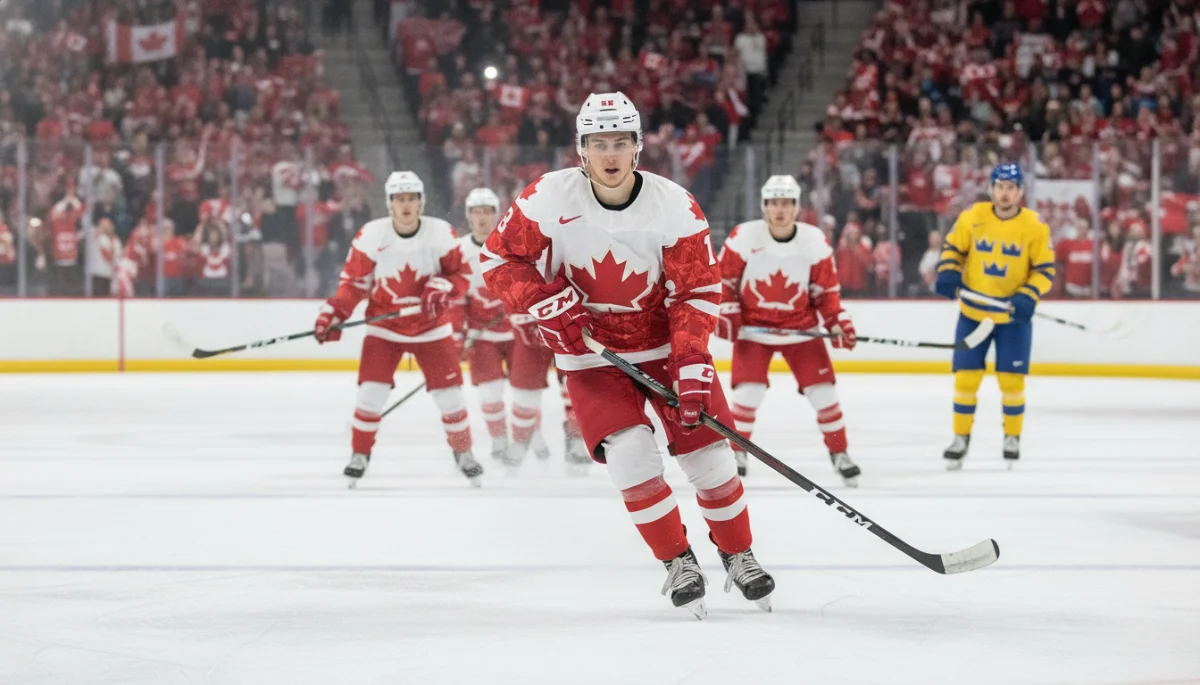
Canada has already locked up a semifinal berth at the 2026 Hlinka Gretzky Cup, and that changes the meaning of its final preliminary game only slightly. The result against Sweden still matters, but the larger objective has shifted toward building momentum for the knockout rounds.
After convincing wins over Switzerland and Slovakia, Canada finishes Group A on Wednesday, August 5, at Rogers Place in Edmonton. The game is set for 5 p.m. Mountain Time and 7 p.m. Eastern Time.
With two regulation victories and six points, Canada cannot be caught for first place in the group. Switzerland sat in second before Wednesday’s slate, while Sweden and Slovakia were still chasing the remaining semifinal position.
That cushion removes the pressure of qualification, but it does not remove the importance of the matchup. Canada still gets one more chance to sharpen its game before the tournament turns into a win-or-go-home race.
A Strong Opening Has Set the Tone
Canada’s tournament began with a 7-3 win over Switzerland on August 3, a game that showed how quickly this roster can overwhelm opponents when its depth starts rolling. The Canadians struck five times in the opening period and finished with a 48-25 shot advantage.
Liam Pue scored twice in that opener, and Brock England, Camryn Warren, Ryerson Edgar and Benjamin Veitch also scored. England later added a short-handed goal in the third period to complete his two-goal night.
The second game looked even more one-sided. Canada beat Slovakia 6-1 and again controlled the pace from the start.
Kayden Stroeder scored twice, while Landon DuPont, Warren, Edgar and Pue all joined the scoresheet. Canada fired 48 shots on goal and limited Slovakia to 13. Leif Oaten turned aside 12 of 13 shots in net, giving Canada another comfortable result built on pressure and pace.
Those two games have already revealed one of Canada’s biggest strengths: production is coming from everywhere. Through two games, Pue, Edgar and Warren each had four points, putting them among the tournament’s scoring leaders. Pue led the Canadians with three goals, and Maddox Schultz had collected four assists.
That spread of offense matters because it makes Canada less predictable. It also gives the team more ways to survive when one line slows down or one opponent succeeds in taking away a top option.
Defensively, Canada has not just been holding the line. Its blue-liners have been active in the attack, helping extend possession and keep pressure in the offensive zone. That kind of balance is often what separates a good junior team from one that can actually win a medal round.
Sweden Brings Pressure of Its Own
Sweden arrives with much more at stake. The Swedes opened with a 4-3 win over Slovakia, then dropped a 7-6 shootout-style battle with Switzerland that kept their path to the semifinals uncertain.
That means Wednesday’s game is not just a test against the group winner. It is also a high-use chance for Sweden to protect its tournament life.
Canada already saw Sweden once in pre-tournament play and came away with a 3-1 victory. Even so, a group-stage meeting carries more weight, because both sides now understand the tournament context and the level of urgency attached to every shift.
Sweden has shown it can score in bunches. Dorian Eklund Aspe entered the game with four points, while Oliver Sundberg and Milan Sundstrom had each scored twice through the first two outings.
For Canada, this is the kind of opponent that can reveal useful details without creating danger in the standings. The staff can watch how the team handles speed, puck movement and defensive-zone pressure against a semifinal-caliber opponent.
Head coach Ryan Oulahen also has room to think beyond the result. He can evaluate line combinations, manage ice time and prepare his group for the tighter, more physical style that usually defines the medal round. Oulahen previously served on Canada’s staff when the program won the tournament in Edmonton in 2024, and he now leads the team as head coach.
The Semifinal Picture Is Still Taking Shape
Because Canada finished first in Group A, its semifinal opponent will be the second-place team from Group B. That matchup is scheduled for Friday, August 7, after the remaining preliminary games settle the final standings.
The tournament bracket sends the Group A winner against the Group B runner-up, while the other semifinal matches the Group B winner with the second-place team from Group A. The two winners move on to the gold-medal game on Saturday, August 8, and the two losers meet for bronze.
The exact opponent was still undecided with the Group B race incomplete. The United States held first place after two games, while Czechia and Finland were tied with three points apiece and Germany had yet to earn a point.
That uncertainty does not change the basic reality: the semifinal will be a major step up in intensity. Canada has learned that lesson before.
At the 2025 event, Canada also ran the preliminary round perfectly before falling 4-3 to the United States in a semifinal shootout. The team recovered to beat Finland for bronze, but the semifinal loss ended its title hopes. That result remains a reminder that strong group play only creates an opportunity; it does not guarantee advancement once the bracket tightens.
Why This Tournament Matters So Much to Canada
Canada’s history in the summer under-18 event explains why expectations are always high. The country has won 25 of the 34 gold medals awarded since the tournament began in 1991, including seven straight from 1996 through 2002 and another run of eight consecutive titles from 2008 through 2015.
The pressure becomes even stronger when the event is held in Alberta. Before the 2026 tournament, Canada had already won gold in each of the province’s previous three editions: Edmonton and Red Deer in 2018, Red Deer in 2022 and Edmonton in 2024. Canada defeated Czechia 2-1 in the 2024 final at Rogers Place.
That history raises the stakes of every home tournament. A strong run this year would extend Canada’s perfect record in Alberta while delivering a 26th summer under-18 gold medal.
It also reinforces why the group stage matters even after a team secures passage to the semifinals. For Canada, playing well now is part of building the confidence and structure required to handle the last two games of the tournament.
A show for the Next Wave
The Hlinka Gretzky Cup is more than a trophy chase. It is also one of the earliest major international stages for players who are moving toward their NHL draft seasons.
The tournament gathers many of the top under-18 players from eight hockey nations, and its timing allows each country to bring a strong roster before club and school obligations interfere. That makes the event especially useful for evaluating future talent in a high-pressure setting.
For Canadian followers, the medal round offers both a title pursuit and a first serious look at prospects who could shape the next few years of junior and professional hockey. DuPont has drawn plenty of attention, but the opening games have also pushed Pue, Edgar, Warren, Schultz and Stroeder into the spotlight.
The semifinal will be their first real elimination game at this level, which should reveal how they respond when every mistake can change the outcome of a tournament.
The Week Ahead Could Define the Tournament
Canada’s game against Sweden will draw interest, but the biggest audience is likely to arrive once the medals are on the line. The semifinals are set for Friday, August 7, and the bronze- and gold-medal games follow on Saturday, August 8. The championship game begins at 5 p.m. Mountain Time, and TSN and RDS are carrying the action from Rogers Place.
Canada has already completed the first step by securing top spot in Group A. What comes next is harder: turning its scoring depth, home-ice advantage and promising collection of young talent into two more wins.
If Canada wins on Friday, it returns to the final and moves one step away from another summer title. If the group-stage form carries over, the country could spend the weekend playing for gold in one of the most watched hockey events of the summer.
The preliminary round suggests Canada has the skill to contend. The medal round will show whether this roster can handle the pressure that comes with chasing a championship on home ice.


Leave a Reply