
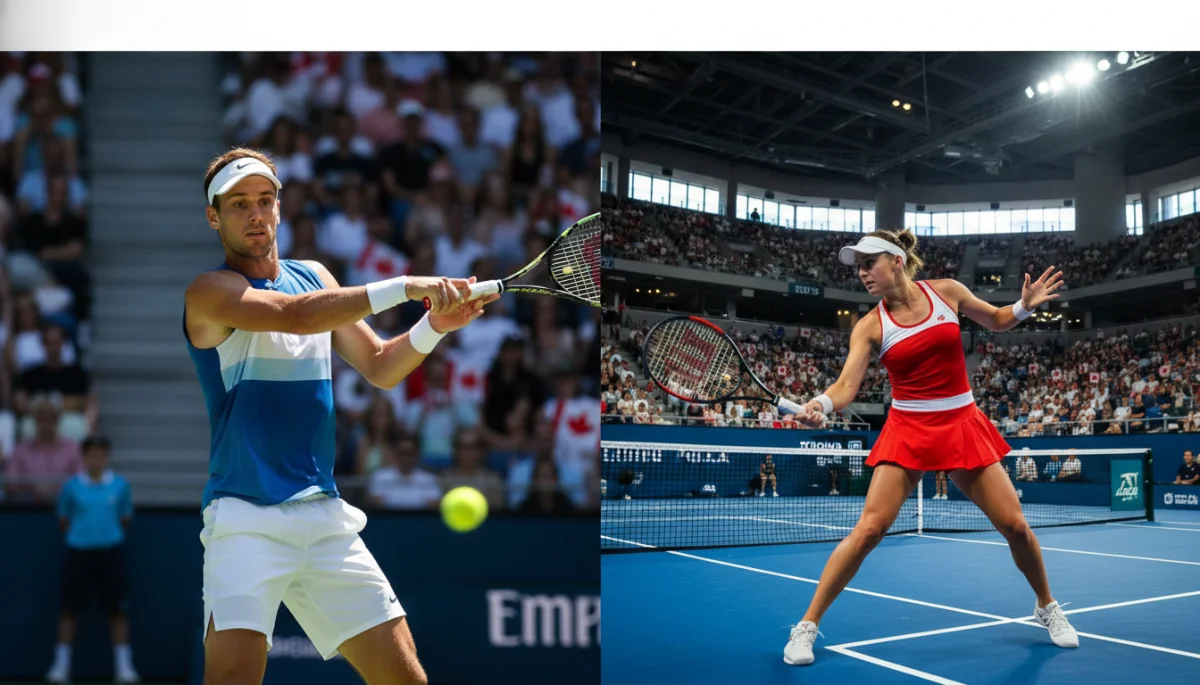
The Omnium Banque Nationale 2026 reaches its round of 16 this weekend, and the next two days will sharply narrow both draws. Montreal’s men and Toronto’s women will each produce eight quarterfinalists by Sunday night.
The tournament has already delivered upsets, withdrawals, and fast starts from several top names, which makes the upcoming matches especially important. Ben Shelton, Casper Ruud, Aryna Sabalenka, Coco Gauff, Jessica Pegula, Mirra Andreeva, and Leylah Fernandez are among the players shaping the conversation.
When the next round begins
The round of 16 is scheduled for Saturday, August 8 and Sunday, August 9, 2026. In Montreal, the main stadium day session starts at 12:30 p.m., while the night session begins at 6:00 p.m..
Toronto follows a similar rhythm, with daytime play beginning at 12:30 p.m. and evening matches starting at 7:00 p.m.. The exact order of play is released the day before each session because match length can shift the schedule.
- Montreal will stage eight singles matches across the weekend.
- Toronto will also feature eight singles matches across the same two days.
- The winners move on to the quarterfinals on Monday, August 10, and Tuesday, August 11.
Montreal: a men’s draw that keeps changing
The men’s bracket has become unusually open after several early exits. Alexander Zverev, Daniil Medvedev, Taylor Fritz, and Andrey Rublev all fell in their first matches, while Félix Auger-Aliassime withdrew with a back injury before he could begin singles play.
That wave of departures removed much of the pre-tournament hierarchy. By the end of the second round, six of the top ten seeds were already out, leaving the field without a clear front-runner.
Ben Shelton has benefited most from the shake-up. The defending champion opened with a 6-3, 7-5 win over Jenson Brooksby and continues to look comfortable on the quick courts at the Stade IGA.
Casper Ruud is another major name to watch. The Norwegian controlled Juan Manuel Cerúndolo 6-1, 6-2 in his opening match and now has a favorable path in a section that no longer looks intimidating.
Who is best placed to capitalize
Shelton’s title defense is one of the central storylines in Montreal. He won the 2025 event for his first Masters 1000 trophy, and his serving power remains one of the most dangerous tools in the draw.
His challenge is consistency. When Shelton keeps points short and avoids overpressing, he can overwhelm opponents; when he rushes, he gives more experienced players a chance to settle in.
Ruud offers a different kind of threat. He is better known for his work on clay, but his improved comfort on hard courts gives him a legitimate chance to go deep if the draw continues to break in his favor.
- Ben Shelton brings elite pace on serve and the confidence of a defending champion.
- Casper Ruud brings structure, patience, and a draw that suddenly looks manageable.
- João Fonseca brings momentum after a statement win over Stefanos Tsitsipas.
- Arthur Fils brings athleticism and a game that fits quick courts well.
- Tallon Griekspoor brings proof that he can beat a top seed under pressure.
Young names have seized the spotlight
The biggest opening for the next generation came from João Fonseca’s victory over Stefanos Tsitsipas. The Brazilian handled the pressure of a tight match and showed the heavy firepower that has made him one of the most exciting young players on tour.
Arthur Fils also advanced after defeating Zachary Svajda in three sets. His speed, physicality, and willingness to attack the ball give him the kind of profile that tends to work well on Montreal’s faster surface.
Tallon Griekspoor delivered one of the tournament’s most notable upsets by rallying past Zverev 6-7, 6-2, 6-4. That win was more than an upset result; it also gave him proof that he can outlast a top opponent across a full match.
In a field stripped of several marquee seeds, confidence may matter as much as ranking. The players who believe the draw is open are now the ones most likely to keep winning.
Toronto: the women’s field looks much steadier
The women’s tournament in Toronto has been far more predictable so far. Aryna Sabalenka, Elena Rybakina, Jessica Pegula, Coco Gauff, and Mirra Andreeva all moved through their first matches and into the third round.
Sabalenka remains the player everyone else is chasing. The world No. 1 opened with a 6-3, 6-3 win over Moyuka Uchijima, extending her hard-court winning streak to 13 matches.
Her serve and first-strike power are especially valuable on Toronto’s quick hard courts. Another deep run would also help preserve her hold on the top ranking after the tournament.
The main challengers in Toronto
Elena Rybakina had a tougher opening match, needing three sets to get past Daria Kasatkina. She eventually won 6-3, 5-7, 6-4 in 2 hours and 33 minutes, finishing with 58 winners and 58 unforced errors.
That line tells the story of Rybakina’s game. When her serve is clicking and her timing is sharp, she can dominate almost anyone; when her accuracy slips, she can make life harder for herself than necessary.
Coco Gauff started with a 6-2, 7-5 win over qualifier Kayla Day. She did not always control the rallies, but her speed and defense were enough to carry her through the important moments.
Jessica Pegula needed even more grit. After dropping the first set against Magdalena Frech, she turned the match around and closed out a 3-6, 6-3, 6-1 victory by taking eight of the final nine games.
The Toronto form chart
Mirra Andreeva may have produced the cleanest performance of the top contenders. The Roland Garros champion overwhelmed former world No. 1 Karolina Pliskova 6-0, 6-2 in just 54 minutes.
At 19, Andreeva already plays with unusual composure. She defends well, changes pace naturally, and rarely gives away points without a reason, which makes her especially difficult to rush.
Pegula’s track record in Canada deserves extra attention. She won the event in both 2023 and 2024, so she understands how to manage the physical demands and conditions of the North American summer swing.
Rybakina is also still in position to climb the ranking. A title run could put her ahead of Sabalenka, but only if the world No. 1 exits before the round of 16.
Canada’s remaining hope
Leylah Fernandez is the last Canadian left in singles after beating Renata Zarazúa 6-2, 6-2. She handled the pressure well in front of a home crowd and kept control of the match from the start.
Fernandez lost serve only once and created five breaks, which reflected both aggression and discipline. Her next test is Elise Mertens, a veteran who can stretch rallies and force careful shot selection.
If Fernandez is going to keep advancing, she will need to stay aggressive without becoming impatient. Her best tennis usually appears when she takes the ball early and uses her forehand to move opponents around the court.
For the Canadian fans in attendance, that makes her the player carrying the strongest local interest into the weekend.
How to follow the action
Sportsnet and TVA Sports are the official Canadian broadcasters for the Omnium Banque Nationale. Both networks carry coverage from Montreal and Toronto, and both also provide access through their digital platforms.
Because match lengths can change the order of play, viewers should check the published schedule before each session begins. Weather interruptions can also affect timing, especially in outdoor tournaments like this one.
The next 48 hours should sort out the most legitimate contenders in both cities. Montreal has become unpredictable, Toronto has largely held form, and the weekend now stands to decide who truly belongs in the final eight.


Leave a Reply