
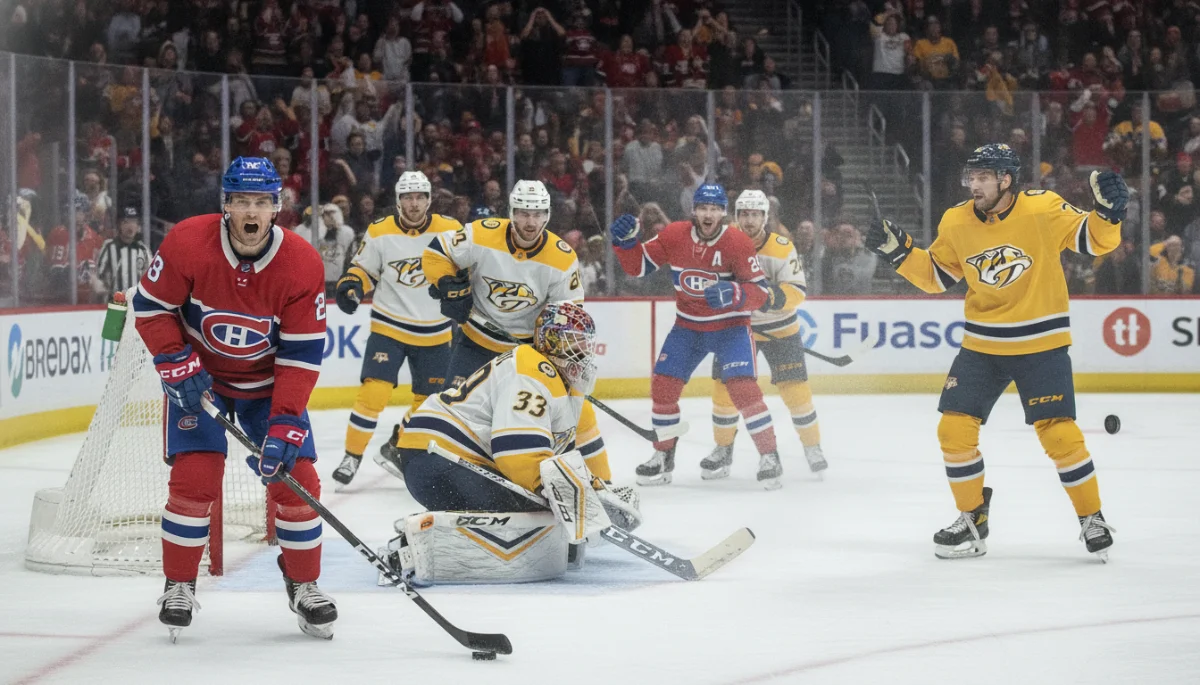
The Montreal Canadiens appeared to have Nashville exactly where they wanted Thursday night. They built a two-goal advantage at Bell Centre, controlled much of the play and repeatedly tested the Predators’ defense.
By the final horn, however, the scoreboard told a very different story. Nashville scored five consecutive goals, including Ryan O’Reilly’s late power-play winner, and left Montreal with a 5-2 victory.
The result pushed the Canadiens’ winless run to three games and left them with a 1-2-1 record early in the season. The defeat was not the product of one disastrous shift. Instead, several smaller failures—missed chances, untimely penalties, a momentum-changing second period and outstanding opposing goaltending—combined to change the game.
Montreal’s Advantage Was Real, but It Was Never Large Enough
The Canadiens did not spend the night being thoroughly outplayed. In fact, long stretches favored Montreal, especially before Nashville began its comeback. The home team moved the puck effectively, established extended offensive-zone possessions and created enough pressure to build a much larger cushion.
Nick Suzuki opened the scoring 3:12 into the second period during four-on-four play. The Montreal captain found a loose puck near the crease and slipped a backhand shot through Juuse Saros for his third goal of the season.
Montreal added another goal at 8:50. Josh Anderson created a turnover behind the Nashville net and sent the puck toward Alex Newhook, who finished from close range to make it 2-0.
At that stage, the Canadiens had the crowd engaged and the Predators under pressure. The problem was that Montreal’s territorial edge produced only two goals. Against a capable opponent and an elite-level goaltender, that margin offered very little protection.
Four Moments That Shifted the Game Toward Nashville
- Saros denied Montreal’s best opportunities: The Nashville goaltender stopped 32 of Montreal’s 34 shots and kept the Predators within reach even when the Canadiens controlled possession.
- Kerfoot ended Montreal’s clean start: Alexander Kerfoot cut the deficit to 2-1 with 4:54 left in the second period, giving Nashville the momentum it had been missing.
- Wood scored at the worst possible time: Matthew Wood tied the game on the power play with only 32 seconds remaining in the second period.
- O’Reilly converted a late penalty: With Mike Matheson in the box for tripping Steven Stamkos, O’Reilly redirected Roman Josi’s shot with 3:16 remaining to put Nashville ahead.
Those moments were connected. Montreal failed to extend its lead, Nashville found life late in the middle frame, and special teams gave the Predators the opportunity to complete the comeback.
The Second-Period Collapse Changed the Emotional Landscape
Kerfoot’s goal did more than reduce Nashville’s deficit. It showed the Predators that Montreal’s control was not permanent. Until then, Nashville had struggled to produce enough sustained offensive pressure to challenge the Canadiens.
The tying goal made the situation even more damaging. Wood’s power-play marker arrived just 32 seconds before intermission, meaning Montreal could not respond with a shift or two before the break. The Canadiens instead had to enter the locker room with a 2-2 score after appearing to be in command minutes earlier.
That timing gave Nashville confidence and forced Montreal to begin the third period as if the game had been reset. A 2-0 lead had disappeared, and the Predators now had proof that their comeback was possible.
Close NHL games often turn on momentum, but momentum usually begins with execution. Nashville finished its chances when they appeared. Montreal did not.
Anderson’s Breakaway Was Montreal’s Best Escape Route
Montreal still had a chance to reverse the direction of the game in the third period. With approximately eight minutes left in regulation, Josh Anderson broke in alone against Saros.
The situation was ideal for the Canadiens. A goal would have restored a 3-2 lead and forced Nashville to chase the game. Saros, however, stayed with the play and stopped Anderson with his left pad.
That save became one of the night’s most important turning points. Nashville survived a dangerous chance, and Montreal never created another goal before O’Reilly’s power-play deflection gave the Predators their first lead.
The sequence captured the difference between the teams. Montreal generated a high-value opportunity but could not finish it. Nashville received its opening later and made it count.
Special Teams Made the Difference
Montreal’s even-strength performance was not enough to overcome Nashville’s advantage on special teams. The Predators scored twice on the power play: Wood’s tying goal in the second period and O’Reilly’s go-ahead goal late in the third.
The Matheson penalty was especially costly because it arrived in a tied game with only a few minutes remaining. When a team is struggling to turn offensive pressure into goals, giving the opponent a late power play creates an unnecessary burden.
Montreal also needed its own power play to provide a response. Nashville’s Saros was playing well, and a strong special-teams shift could have supplied the breakthrough that five-on-five play did not. Instead, the Canadiens went without a comparable swing in their favor.
Discipline will be a major focus when Detroit visits Bell Centre on Saturday. The Canadiens cannot afford to give opponents repeated chances to attack with an extra skater, particularly in one-goal games.
Jacob Fowler Deserves Context After His First Start
Jacob Fowler made his first NHL start of the season after Montreal recalled him from the Laval Rocket. Samuel Montembeault had suffered a lower-body injury during Wednesday’s practice, leaving the Canadiens with an unexpected decision in goal.
Fowler stopped 15 shots in the loss. The final score could make his night appear worse than it was, but two of Nashville’s goals came into an empty net after Montreal pulled him late. Fowler allowed three goals while actually playing in net, and he faced difficult situations on both of Nashville’s power-play tallies.
That does not mean every goal was unavoidable or that Fowler had a perfect performance. Young goaltenders will always find details to improve after a defeat. Still, assigning the loss primarily to Fowler would overlook Montreal’s larger issues.
The Canadiens did not finish enough chances, allowed Nashville to tie the game before the second intermission and gave up a late power-play winner. Those breakdowns affected the outcome more than the raw 5-2 score suggests.
Montembeault’s Status Adds Pressure to the Position
Montreal’s goaltending situation now carries additional uncertainty. Fowler has NHL experience, having appeared in 17 games last season while posting a 9-6-2 record, a 2.43 goals-against average and a .908 save percentage.
Those numbers indicate that Fowler is not unfamiliar with professional pressure. Even so, there is a difference between occasional NHL action and being asked to handle meaningful starts because of an injury early in the season.
If Montembeault is unavailable for more than a short period, Montreal must protect its goaltender more effectively. That means limiting penalties, reducing traffic around the crease and doing a better job of controlling rebounds.
Saros Allowed Nashville to Stay Alive
Juuse Saros was the central reason the Predators remained close enough to rally. Montreal’s 34 shots produced only two goals, while Saros repeatedly prevented the Canadiens from turning extended pressure into a decisive advantage.
His stop on Anderson stood out, but his influence stretched across the game. Every save preserved the possibility of a Nashville comeback. Once Kerfoot scored, the Predators no longer needed to overcome a large deficit; they only needed one more strong sequence.
That is why the loss should not be described as a complete Montreal breakdown from the opening faceoff. The Canadiens were competitive and, at several points, the more dangerous team. Saros prevented their best stretches from becoming an insurmountable lead.
The Scoreboard Hid How Close the Game Was
Adam Edstrom scored twice into an empty net in the final minutes, turning a one-goal game into a 5-2 result. Those goals mattered to the final outcome, but they also distorted the impression of how the game had unfolded.
Montreal was not three goals worse than Nashville throughout regulation. The Canadiens had the better start, held a 2-0 lead and generated enough opportunities to win. Their failure was not a lack of competitiveness; it was an inability to close the game.
That distinction matters for a young team. A poor performance requires a broad correction. This game called for more specific improvements:
- Convert strong offensive-zone shifts into additional goals.
- Finish breakaways and other high-quality scoring chances.
- Avoid penalties when the score is tied late.
- Give the goaltender cleaner sightlines and stronger defensive support.
- Use special teams to create momentum instead of surrendering it.
Suzuki Remains a Reliable Offensive Starting Point
Nick Suzuki provided one of the clearest positives. His second-period goal was his third of the young season, and it came from the kind of direct play Montreal needs around the net.
The captain’s willingness to attack loose pucks and finish in traffic can set the tone for the rest of the lineup. With injuries affecting the roster and the club searching for consistency, Suzuki’s production will remain central to Montreal’s success.
Alex Newhook also found the net, while Anderson’s forechecking helped create the turnover that led to the goal. Those contributions show that Montreal’s offense can manufacture chances. The next step is making sure that pressure produces enough separation before the opponent responds.
Detroit Provides an Immediate Test
The Canadiens will not have much time to dwell on the defeat. Detroit visits Bell Centre on Saturday, giving Montreal a quick opportunity to correct the details that cost it against Nashville.
The response will reveal more than the 1-2-1 record alone. Montreal must show that a strong performance does not have to end in frustration simply because one opponent makes a late push.
Against Detroit, the Canadiens need to protect any early advantage, stay composed when the game tightens and attack the net with greater urgency. If Montembeault remains out, the skaters must also make Fowler—or whichever goaltender starts—the beneficiary of better defensive structure.
Thursday’s defeat was painful because Montreal had the ingredients for a win. The Canadiens established control, scored twice and created the chances required to finish the job. They simply did not execute at the moments that mattered most, while Nashville did.
The lesson is straightforward: possession and pressure are only valuable when they become goals, and a two-goal lead is never secure without discipline and finishing. Saturday offers Montreal the chance to prove that the collapse against Nashville was a warning rather than a pattern.


Leave a Reply