
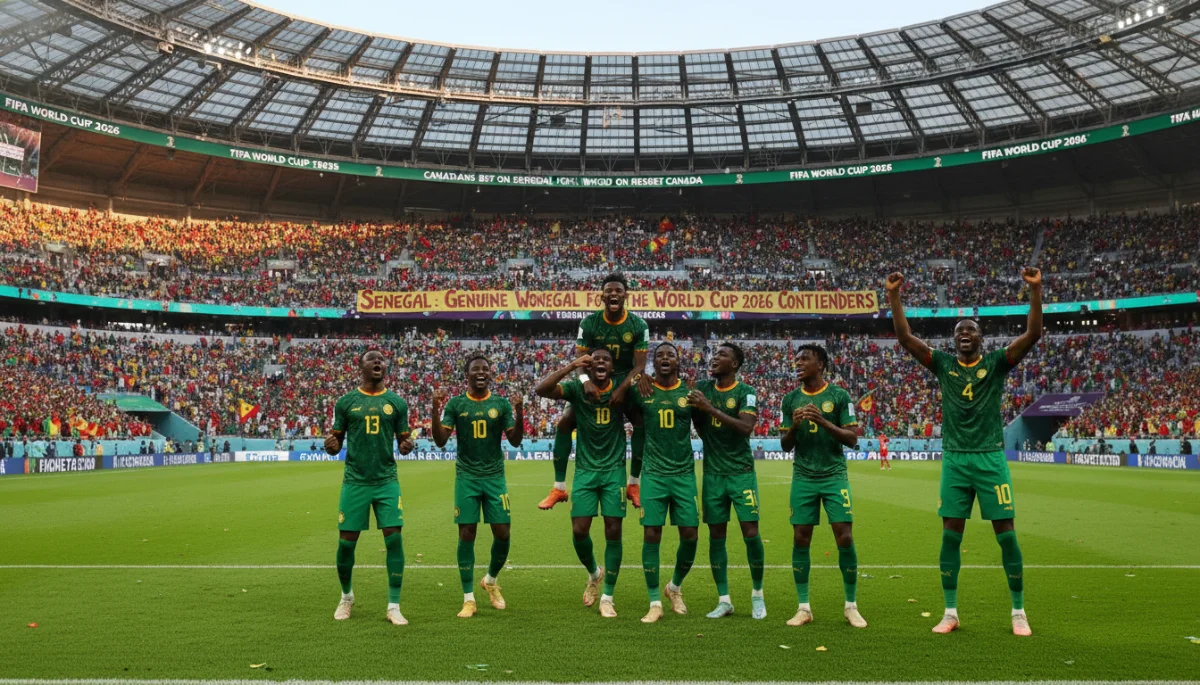
Senegal is entering the 2026 World Cup conversation with real ambition, not polite hope. Pape Thiaw’s insistence that he would walk away if he did not believe his squad could win reflects how far the national team’s mindset has shifted, and that confidence is now taken seriously across the sport.
The Lions of Teranga have become one of Africa’s most reliable contenders, blending veteran experience with a fresh wave of elite prospects. For supporters and bettors who track longshot value, the Senegal World Cup 2026 prospects look more credible than the usual underdog narrative. Canadians can bet on Senegal for the World Cup on Rexbet Canada, where the appeal is obvious: a team with proven international quality and room to improve.

That optimism, however, sits beside a more complicated reality. Senegal’s rise has been powered by a system that works extremely well for the national side while placing heavy pressure on the country’s domestic football economy. The same model that keeps producing stars also funnels value outward, often before local clubs can benefit in a meaningful way.
A Talent Pipeline Built on Precision
Senegal’s football output is remarkable for a country of about 20 million people. Its academies produce far more top-level players than nations with much larger populations, and they do so with a structure that is both disciplined and export-oriented.
- Generation Foot, Diambars, and Dakar Sacre Coeur are among the country’s most important development centers.
- These academies combine coaching, schooling, and medical support in ways that prepare teenagers for Europe’s top leagues.
- Players are often identified early and moved quickly into international pathways that accelerate their careers.
That model has created stars such as Sadio Mane, Ismaila Sarr, and Pape Matar Sarr, but it also reveals a hard truth: Senegal is excellent at producing value, and less effective at retaining it. Many of the country’s best prospects enter Europe through long-standing partnerships that favor the buying club’s long-term control over the academy’s financial upside.
Why the Money Problem Matters
The financial imbalance is not abstract. A review of 13 academy-trained players who went on to represent Senegal showed that their local academies collected only €100,000 in initial transfer fees, while European clubs later generated €81.2 million from selling those same players onward. Across their careers, the combined transfer value tied to those players has surpassed €411 million.
That gap helps explain why Senegalese football can look internationally strong while domestic infrastructure lags behind. Local clubs continue to operate with limited resources, aging stadiums, and reduced visibility, even as their training work helps fuel major European profits.
- Local academies often receive only a small share of eventual player wealth.
- Domestic stadium conditions remain weak in many areas.
- The national league still struggles for attention compared with Europe’s major competitions.
- Even required solidarity payments can become disputed, delayed, or mishandled.
Cases involving major transfers, including Nicolas Jackson’s €37 million move to Chelsea, have underscored how administrative friction can make a legal entitlement difficult to secure. The result is a system that produces excellence on the field while leaking economic value away from the people who built the foundation.
The Diaspora Advantage
Senegal’s rise is not driven by academy development alone. The federation has also become highly effective at recruiting dual-national players from the diaspora before they fully commit elsewhere.
Instead of losing top prospects to France, England, or other European powers, Senegal now acts earlier and more strategically. It targets players between 16 and 19, leans into family identity and cultural continuity, and offers a clear sporting argument: this is a national team capable of competing at the highest level.
Recent additions such as Ibrahim Mbaye and Mamadou Sarr show how effective that strategy has become. Both players previously represented France at youth level, yet Senegal was able to make a strong case for their long-term international future.
What 2026 Could Mean
The 2026 tournament may be the defining moment for Senegal’s established core. For players such as Sadio Mane, Kalidou Koulibaly, and Edouard Mendy, this is likely the final World Cup stage on which they can shape their legacy.
At the same time, the squad now looks unusually deep. Veteran leaders can share space with teenagers who bring pace, freshness, and technical quality. Idrissa Gana Gueye, now 36, could still be part of a lineup that also includes players just beginning their international careers.
That mix gives Senegal a legitimate chance to survive the pressure of a demanding group and remain dangerous in knockout football. Their physicality, organization, and tactical discipline make them difficult to face, even for more traditional powers.
The challenge begins immediately. Group I includes France, Norway, and Iraq, and the opening match against France in New Jersey will be a direct test of Senegal’s level. If they can escape the group, few opponents will want them in a one-off elimination match.
Senegal’s World Cup story is therefore both inspiring and uneasy: a nation that has learned how to build a contender, but still has to fix the system that makes that success possible.


Leave a Reply